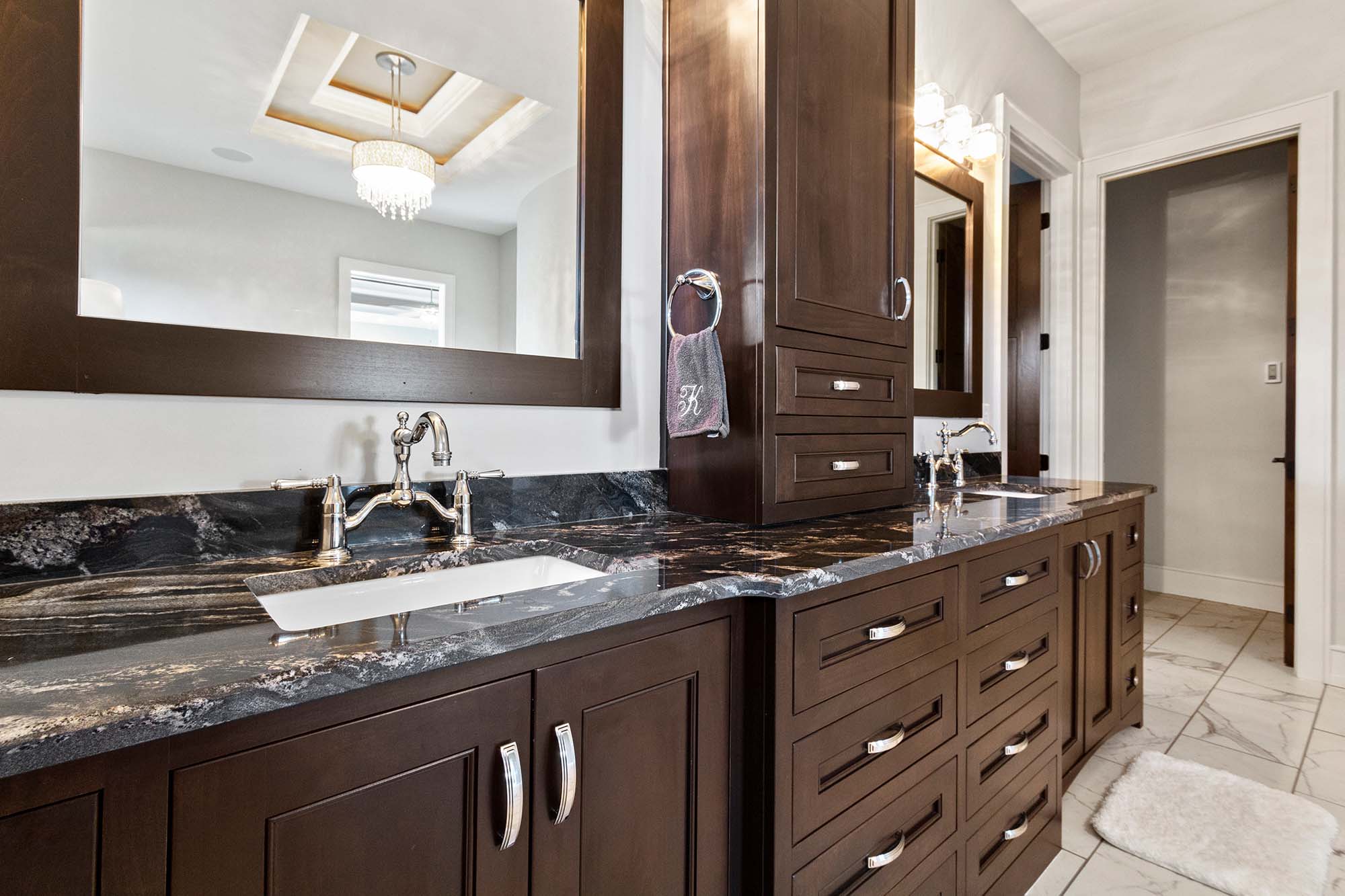
Quartz and quartzite sound like they should be nearly identical, and that assumption trips up more homeowners during a countertop selection than any other single point of confusion. The two materials are almost nothing alike in how they are made, how they perform, and in one case, what is actually sitting on a showroom floor labeled with the wrong name entirely.
One Is Manufactured, One Is Cut From the Earth
Quartz countertops are engineered, meaning ground quartz mineral is combined with resin binders and pigment, then compressed and cured into slabs. This manufacturing process is why quartz slabs show such consistent, repeatable patterns, since the material is essentially designed rather than discovered.
Quartzite is a natural metamorphic stone formed when sandstone is subjected to intense heat and pressure underground over a very long period of time. That geological origin is also why quartzite slabs vary significantly from one to the next, even within the same quarry lot, since no two sections of stone experienced identical pressure and mineral content during formation.
The Industry Problem Almost Nobody Talks About
Here is something most countertop articles skip entirely. A significant amount of material sold commercially as quartzite is not actually true quartzite at all, it is dolomitic marble or a softer calcite based stone that resembles quartzite closely enough to pass in a showroom. This happens because true quartzite is extremely hard to quarry and fabricate, so some suppliers apply the more marketable name to softer stone that shares a similar look.
The practical impact is real. True quartzite scores close to seven on the Mohs hardness scale and resists etching from acidic foods, while the softer marble imitators sold under the same name etch and scratch far more easily, closer to how actual marble performs. A simple way to protect yourself is to ask directly whether the specific slab has been tested for hardness, or to request the supplier's documentation on the material's actual mineral composition rather than relying on the name alone.
How Each Material Performs Day to Day
Quartz never needs sealing because the resin binding process creates a nonporous surface from the start, which is a major part of its appeal for busy kitchens. It also maintains a completely uniform look across an entire countertop, which some homeowners prefer for a clean, consistent aesthetic throughout a kitchen.
True quartzite does require periodic sealing since it remains a natural porous stone, though its hardness makes it more resistant to scratching than granite or marble once properly sealed. The tradeoff for that natural stone authenticity is a maintenance routine that quartz simply does not require, along with the natural variation between slabs that some homeowners see as a feature rather than a drawback.
Which One Actually Fits Your Kitchen
Homeowners who want zero maintenance and predictable, repeatable patterns across an island and perimeter counters tend to lean toward quartz, since it removes sealing and etching concerns from the equation entirely. Homeowners drawn to the organic movement and one of a kind character of natural stone, and who do not mind periodic resealing, often find that true quartzite delivers a look engineered quartz cannot fully replicate.
Neither material is the objectively better choice, since the right answer depends entirely on how much natural variation and maintenance a household is willing to take on in exchange for that one of a kind appearance. Seeing verified slabs of both side by side, with documentation on what you are actually looking at, remains the only reliable way to make this decision with confidence.
If you want to see verified quartz and true quartzite slabs side by side before you decide, Heartland Cabinetry & More can walk you through exactly what you are looking at. We serve homeowners throughout Bourbonnais, Kankakee, Manteno, Watseka, Bradley, and the surrounding areas and invite you to view documented slab options in person at Bourbonnais, IL. Explore our Custom Countertops selection or contact us to compare materials for your kitchen.