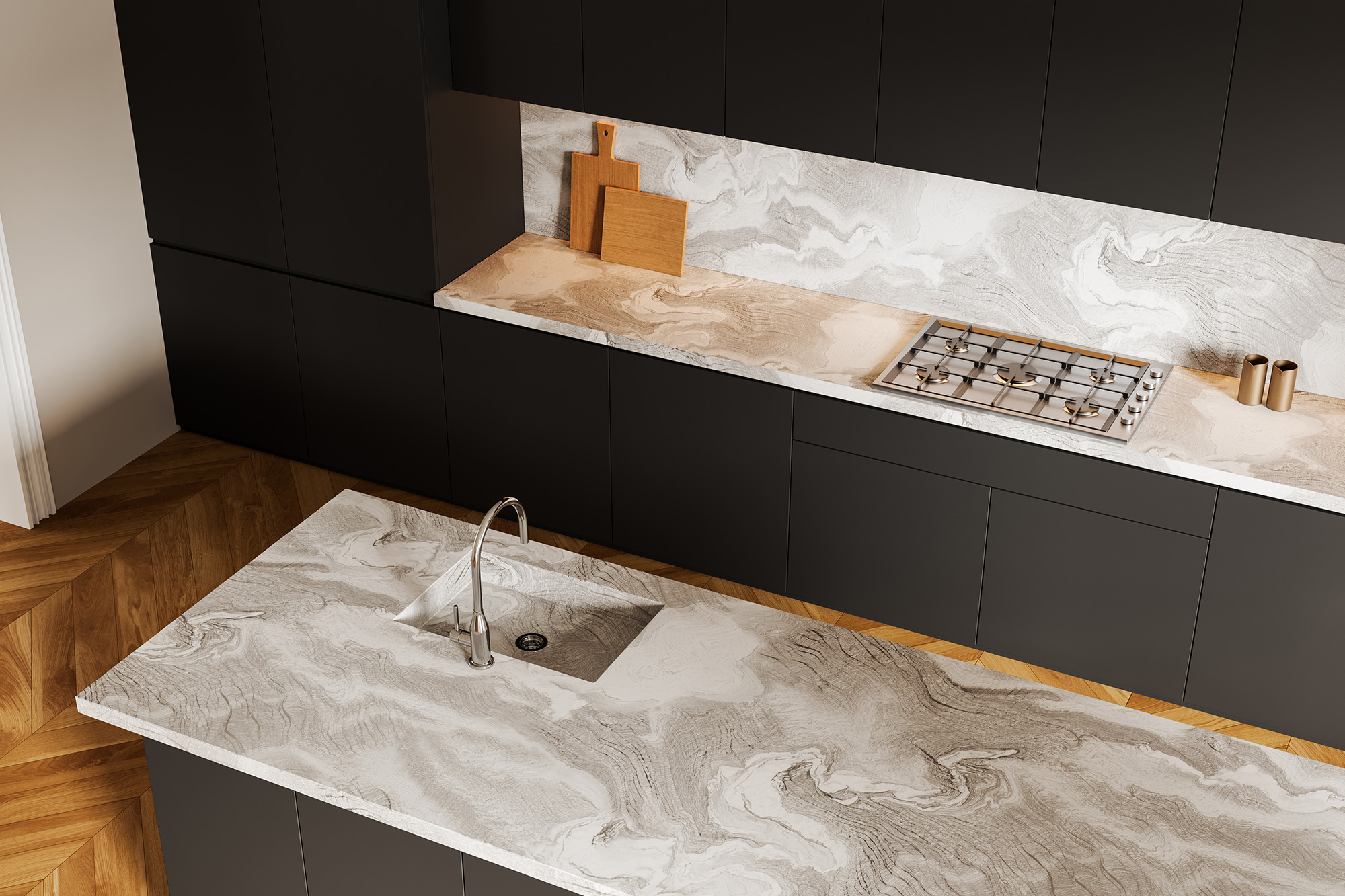
Walk into a kitchen that is fifteen years old and the counter near the range usually looks fine while the area around the sink tells a different story. Homeowners across Bourbonnais, Kankakee, Manteno, Watseka, Bradley, and the surrounding areas tend to read that as a material problem and start looking at replacements. Often the material was never the issue. The sink zone is the only part of a countertop facing heat cycling, chemical exposure, physical impact, and constant moisture in the same square foot, and a few details decide how well it handles all four.
Four Kinds of Stress in One Place
Consider an ordinary evening at a sink. A pan of boiling water gets poured out, then the cold tap runs. That is a rapid temperature swing at the cutout edge, and repeated over years it works on any material and on the adhesives holding things together. Cleaning products, citrus, coffee, and wine all land here more than anywhere else, so chemical exposure concentrates in one spot. Dishes get set down hard on the edge, which is mechanical impact at the most vulnerable point in the slab. And the whole area stays damp far longer than the rest of the counter.
No other part of a kitchen combines all four. The range area sees heat but stays relatively dry. A prep zone sees impact and spills but not thermal cycling. This reframes the question usefully. The thing to ask is not which material never fails, since every material has a different weak point and none is immune, but which details around the sink reduce how much stress reaches the material in the first place.
The Undermount Reveal Almost Nobody Discusses
When a sink mounts beneath the counter, the fabricator decides how the cut edge of the counter relates to the sink rim. A positive reveal leaves part of the rim visible, creating a small ledge where the two meet. A negative reveal has the counter extending slightly over the rim, giving a very clean look from above. A zero reveal aligns the two exactly, which is the most demanding to fabricate. All three are legitimate and all three are in use in good kitchens.
They behave differently over time, and that is the part rarely explained before anyone chooses. A positive reveal leaves a horizontal ledge that collects residue and needs deliberate cleaning. A negative reveal looks excellent but creates a slight lip you cannot easily wipe under, so water sits in the junction. A zero reveal avoids both but leaves no tolerance, so it depends entirely on precise fabrication and a sink whose rim is genuinely consistent. Knowing the trade off before templating lets you choose based on how your household actually cleans.
The Silicone Joint Is a Consumable, Not a Permanent Fixture
The seal between the sink and the underside of the counter is silicone, and silicone has a service life. It stays flexible for years, then gradually hardens, shrinks slightly, and loses adhesion at the edges. Once that happens, water passes through and reaches the cut edge of the substrate and the top of the cabinet below. In most countertops that come apart around the sink, this is the actual sequence rather than a failure of the surface material itself.
Homeowners almost universally treat this joint as permanent because nothing tells them otherwise. It is worth inspecting periodically for discoloration, a hairline gap at the edge, or silicone that has gone hard and brittle instead of staying rubbery. Renewing it is straightforward maintenance and considerably easier than dealing with a swollen cabinet base later. The same applies around the faucet base and any soap dispenser or air gap, where standing water gathers around the escutcheon and wicks into the cutout edge once the seal has gone.
Two Details Worth Asking About Before Fabrication
Seam placement is the first. A sink cutout removes a large section of material, and the area around it carries more load than the rest of the run. Where a seam is unavoidable, a good fabricator plans it away from the cutout rather than across it. This rarely comes up with homeowners because it sits firmly in the fabricator's domain, but it is a reasonable thing to ask about when the layout is being planned, particularly on a long run where a seam has to go somewhere.
The second is the dishwasher. A dishwasher vents hot, humid air at the end of its cycle, and that air rises against the underside of the counter directly in front of it. Most installations include a heat shield or moisture barrier strip for exactly this reason, and it is occasionally omitted or damaged during a later appliance swap. Since it sits out of sight, it tends to go unnoticed until the front edge or the substrate beneath shows the effect. Checking it is present, especially after a dishwasher has been replaced, protects the most exposed edge in the kitchen.
None of this makes one countertop material better than another, and the right surface still depends on how you cook and how much upkeep suits you, which we cover separately in our guide to choosing a countertop that will not stain or scratch. What these details decide is how long whichever material you choose keeps looking the way it did on day one.
If you are planning new countertops, or the area around your sink has started to show its age, Heartland Cabinetry & More can talk through the mounting, sealing, and seam details that make the difference. We serve homeowners throughout Bourbonnais, Kankakee, Manteno, Watseka, Bradley, and the surrounding areas, and you can see slabs, sink options, and edge treatments in person at Bourbonnais, IL. Explore our Custom Countertops selection or contact us to get started.